imghero vs Midjourney for Blog Images (2026)
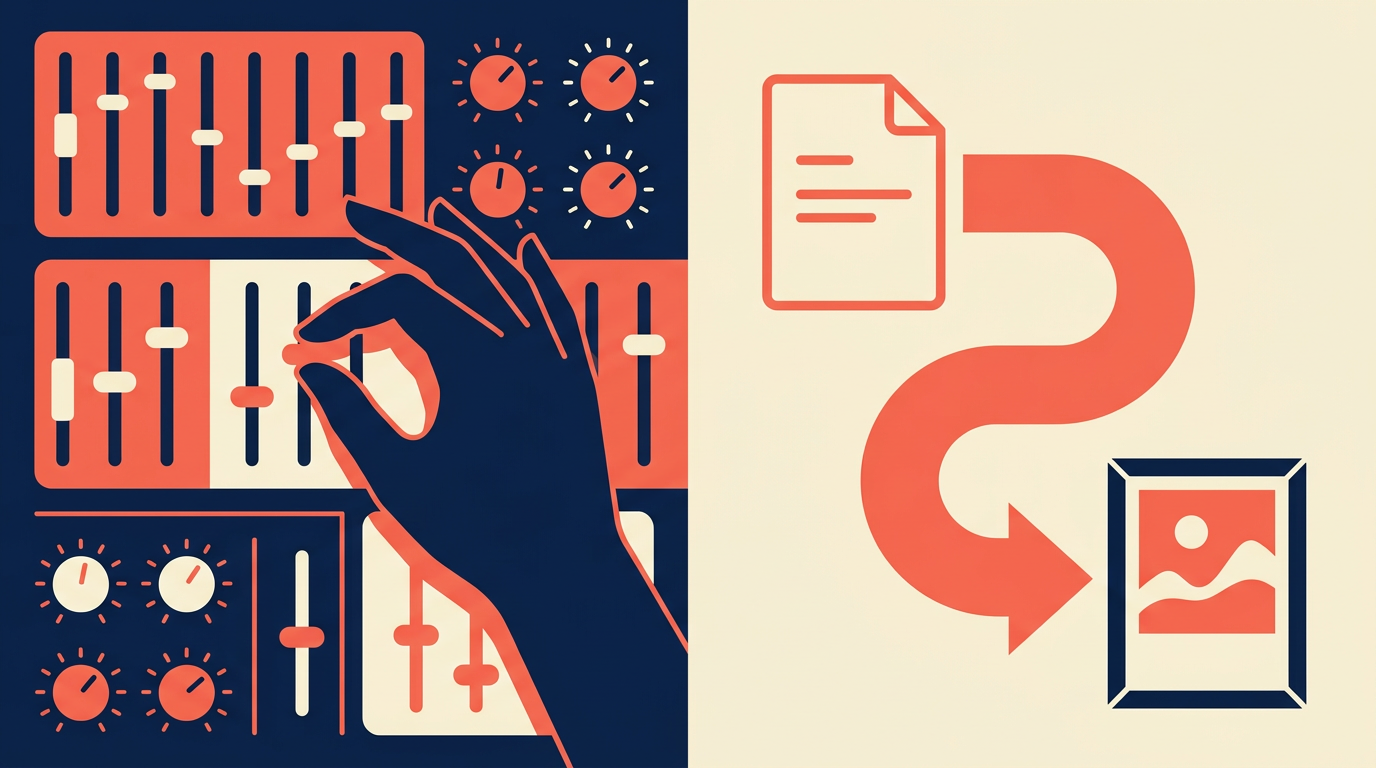
Midjourney generates stunning images. Nobody’s arguing that. The problem is doing it consistently, on schedule, with brand colors, week after week, when you’d rather be writing.
We’ve tested both workflows. Here’s when Midjourney makes sense for blog imagery, when it doesn’t, and how imghero approaches it differently.
Midjourney for Blog Images: What You’re Actually Signing Up For
Midjourney is a text-to-image generator. Write a prompt describing what you want (“minimalist illustration of a developer reviewing code, warm lighting, muted tones”), and it generates four variations. Pick one, upscale it, download it, drop it in your post.
Version 7 (released April 2025) brought real improvements for blog use. Anatomical errors dropped roughly 40%. The web interface replaced Discord-only access, adding visual controls for quality, chaos, and style weight. Draft mode generates images 10x faster at half the GPU cost.
Image quality is excellent for creative work. Midjourney still produces some of the most visually striking AI imagery available.
The workflow is where things get heavy. Every blog image requires:
- Reading your post and deciding what visual works
- Writing a prompt that describes the image
- Reviewing four options and picking the best one
- Running variations if none of the four land
- Upscaling the final image
- Downloading and resizing for your blog dimensions
- Repeating this for every post
For a one-off project, fine. Publish weekly and you’re spending 80+ minutes a month just on image prompts (assuming 10 minutes per image across 8 posts).
How Much Does Midjourney Cost for Blogging?
Midjourney has four subscription tiers. There’s no free plan (free trials were removed after a surge of new users overwhelmed the system).
| Plan | Monthly Price | Fast GPU Hours | Relax Mode | Commercial Use |
|---|---|---|---|---|
| Basic | $10/mo | 3.3 hrs (~200 generations) | No | Yes |
| Standard | $30/mo | 15 hrs | Unlimited | Yes |
| Pro | $60/mo | 30 hrs | Unlimited | Yes (required if revenue >$1M) |
| Mega | $120/mo | 60 hrs | Unlimited | Yes (required if revenue >$1M) |
Annual billing saves 20%, bringing Basic to ~$8/month.
The effective cost per blog image is higher than the plan math suggests. Those 200 Basic plan generations aren’t 200 finished blog images. Most prompts need 2-4 rounds of iteration before anything’s usable, so a realistic estimate is 50-80 publication-ready images from 200 generations. That puts the effective cost at $0.12-0.20 per image. GPU hours don’t roll over either. Unused hours expire at the end of the billing cycle.
Commercial licensing matters for monetized blogs. All paid plans include commercial rights, but free trial images use a Creative Commons NonCommercial license. Running ads, affiliate links, or sponsored content means you need a paid plan. Companies grossing over $1M annually must subscribe to Pro or Mega.
Midjourney images are public by default. Generated images are visible to other users and can be remixed. Only Pro and Mega plans include Stealth Mode for private generations. On lower plans, your branded blog imagery is effectively open for anyone to see and reuse.
5 Midjourney Pain Points for Regular Blog Publishing
Midjourney is built for creative exploration. Blog publishing is a production workflow. They don’t fit together cleanly.
1. Every image needs a prompt.
There’s no shortcut. Good prompts require understanding Midjourney’s parameter syntax (--ar 16:9 --sref [code] --sw 85 --q 2), composition terminology, and style references. The prompt-to-output relationship is unpredictable, so iteration isn’t the exception.
2. No API, no automation. Midjourney explicitly prohibits automated access in its Terms of Service. There’s no official API. You can’t wire it into a publishing pipeline, trigger generations from a CMS webhook, or batch-process images for a month of posts. One developer on Hacker News noted that Midjourney’s leadership has “deliberately chosen not to provide an API” because they want to serve individual creators, not infrastructure use cases.
3. Brand consistency is manual work.
Midjourney offers --sref (style reference) and --cref (character reference) parameters for consistency. They help, but they’re not automatic. You have to remember your style reference codes, include them in every prompt, and manually verify the output still matches your brand. Style drift is a known issue. Users report getting 3-4 consistent images before output starts wandering. Keeping visual coherence across 20+ posts takes deliberate effort every single time.
4. GPU hours expire monthly. The Basic plan’s 3.3 fast hours and Standard’s 15 hours don’t carry over. Publish in batches one week, nothing the next, and you’re paying for capacity you won’t use. Standard and higher plans offer Relax Mode (unlimited but slower), with queue times of 0-30 minutes during peak hours.
5. Output needs resizing.
Midjourney’s default output is 1024x1024 pixels. Blog hero images typically need 1200x675 (16:9) or similar wide formats. Specifying --ar 16:9 helps, but the output resolution may still need resizing for your blog template, OG image requirements, or social preview cards.
imghero vs Midjourney: Side-by-Side Comparison
| imghero | Midjourney | |
|---|---|---|
| Input | Paste a URL | Write a text prompt |
| Content understanding | Automatic (scrapes and summarizes your page) | Manual (you interpret your content) |
| Time per image | 10-30 seconds | 5-15 minutes (with iteration) |
| Brand colors | Set once, applied automatically | Include in every prompt manually |
| Visual styles | 18 built-in (select from menu) | Unlimited (describe in prompt) |
| Text in images | 3 treatment options + 6 font styles | Unreliable text rendering |
| Output size | 1200x675px (blog-optimized) | 1024x1024 default (needs --ar flag) |
| API | Full REST API | None (prohibited by TOS) |
| Automation | Zapier, webhooks, CI/CD | Manual only |
| Free tier | 3 images (no credit card) | None |
| Starter pricing | €9/mo for 20 images | $10/mo for ~200 generations |
| Credit rollover | Yes (up to 2x monthly allowance) | No |
| Image privacy | Private by default | Public by default (Stealth costs $60+/mo) |
Midjourney is the better choice for custom creative projects where you want full artistic control, one-off illustrations where you’ll spend 30 minutes perfecting the prompt, or art-directed campaigns with a designer running the process. Its creative ceiling is higher because you control every visual detail through prompting.
imghero is for teams that publish on a schedule and don’t want to think about image generation at all. It’s built for weekly publishing, API-driven automation, and anyone who’d rather spend that 80 minutes writing content instead.
How imghero Generates Blog Images from a URL
Instead of asking for a prompt, imghero reads your content and figures out what to generate.
The pipeline runs in four stages:
- Scrape your page and extract the content
- Summarize the content, detecting the topic, vertical (tech, finance, travel, etc.), and language
- Optimize a visual prompt based on the summary, your brand colors, chosen style, and text treatment
- Generate the image using Flux models at 1200x675px
The whole process takes 10-30 seconds. No prompt writing, no iteration, no resizing.
Pick from 18 visual styles (photo, illustration, minimal, cinematic, watercolor, and more) or let the auto-selector match a style to your content type. Three preset styles (soft, dark glass, SaaS hero) use reference images for tighter consistency across posts.
Brand colors are stored in your account settings and applied automatically to every image, so your blog maintains a cohesive look without per-image effort.
For automating blog images, the REST API accepts a URL and style and returns a stable image link. Pair it with Zapier to auto-generate hero images when you publish in WordPress, Ghost, or any CMS with webhooks.
Non-English content gets detected and handled automatically. A German blog post generates imagery with culturally appropriate aesthetics, no language configuration needed.
Can You Use AI-Generated Images on Your Blog?
Google has confirmed that AI-generated images won’t cause ranking penalties. Their guidance focuses on content quality and helpfulness, not the production method.
A few things worth knowing:
Midjourney licensing by tier:
- Paid plans: full commercial rights, no attribution needed
- Free trial: CC BY-NC 4.0 (non-commercial only, attribution required)
- Revenue >$1M: Pro or Mega plan required
Copyright gray area: AI-generated images likely aren’t copyrightable under current U.S. law due to lack of human authorship. You can use them freely, but you also can’t prevent others from generating similar images with similar prompts. For blog hero images, this is rarely a practical issue.
SEO tip: Always add descriptive alt text to blog images. Search engines can’t determine image origin, but they evaluate alt text for relevance and accessibility.
FAQ
Is Midjourney worth it just for blog images? Depends on volume. At 1-2 posts per month, and if prompt engineering doesn’t bother you, Basic at $10/month gives plenty of generations. At weekly publishing, 8 posts a month at 10 minutes per image is 80 minutes of prompt writing that adds nothing to the writing itself.
Can I automate Midjourney for my blog? No. Midjourney’s Terms of Service prohibit automated access, and there’s no official API. All generation happens through the web interface or Discord. Third-party API wrappers exist but violate TOS and risk account termination.
What image size does Midjourney output?
Default is 1024x1024 pixels. Use --ar 16:9 for blog-friendly wide images. Upscaling to 2048x2048 is available through Subtle or Creative upscalers. Resizing for your specific blog template is likely still needed.
Do AI images hurt SEO? No. Google has stated AI-generated content (text and images) doesn’t receive ranking penalties. Focus on image quality, relevant alt text, proper file sizing, and page load speed.
Which is cheaper for 20 blog images per month? imghero’s Starter plan costs €9/month for 20 images with rollover. Midjourney’s Basic plan costs $10/month for approximately 200 generations, but producing 20 polished blog images typically requires 60-100 generations (3-5 iterations each). Both are affordable, but Midjourney requires significantly more time per image. Factor in 10-15 minutes per Midjourney image versus 30 seconds with imghero, and the real cost difference is your time.
What are the best AI blog image generators? The best tool depends on your workflow. Midjourney excels at creative, art-directed images. DALL-E 3 (via ChatGPT) handles text in images better than most. imghero is purpose-built for blog publishing, generating images directly from your URLs without prompting. For a full breakdown, see our comparison of AI blog image generators.
Try imghero free. Paste a URL and get a blog image in under 30 seconds. No prompts, no credit card. Get started →
Stop wasting time on images
Your content deserves better visuals
Paste a URL. Get a stunning image. It's that simple.
Start Creating

